Nov 11, 2015

ECM Avamar Virtual Edition Overview

.


Avamar Virtual Edition runs on a SLES-based operating system. The Avamar Virtual Edition
servers are licensed by capacity. Avamar Virtual Edition servers are available in 0.5 terabyte, 1
terabyte, 2 terabyte, and 4 terabyte licenses. Each of these license capacities have their own set
of requirements for memory, I/O, and storage.
ESX versions 5.1i, 5.5i, and 6.0i and Windows 2012 and 2012 R2 are supported by the newest
versions of AVE. A single physical host server can host up to two AVE servers, as long as those
servers are either 0.5 or 1 TB. For 2 and 4 TB capacities, only one AVE per host server is allowed


All Avamar Virtual Edition capacity models except the 4 TB model require a minimum of two full
equivalent processors of 2 GHz available at all times. The 4 TB model requires four 2 GHz
processors. The servers should have at least a 1 GbE network connection. Integration with
VMware VMotion is supported allowing the AVE virtual machine to be migrated seamlessly
between ESX servers. Direct Attached Storage (DAS) and Storage Area Network (SAN) are
supported so that the ESX server can use both types of storage. The mapping of a the AVE’s
virtual disk to a pass-through SCSI device, known as Raw Device Mapping or Pass-Through Disks
is not supported.


The memory, I/O, storage partition requirements for AVE 0.5 TB capacity are listed here. Please
take a moment to review them.
The Read, Write, and Seek performance numbers are gathered using the Avamar Benchmark tool.
The requirements listed do not include the memory required for hypervisor, service console, and
other applications. The users, admin, and dpn home directories and management databases are
stored on the Operating System partition


On average, a file server-only environment has a 0.3% average daily change rate, while a mixed
environment has a 3% average daily change rate. These numbers can be used to estimate the
change rates of an environment based on its size. For example, an environment consisting of 1 TB
of file server data will have a change rate of about 3 GB per day.
If the average daily data added to the Avamar Virtual Edition in a file server only environment is
less than 2 GBs per day and less than 5 GBs in a mixed environment, then the half a terabyte
version would be a good fit. If the average daily data added is less than 4 GBs in a file server
environment and less than 10 GB in a mixed environment, then the 1 TB version would be a good
fit. If the average daily data added is less than 8 GBs in a file server environment and less than
20 GBs in a mixed environment, then the 2 TB version would be a good fit. If the average daily
data added is less than 20 GBs in either a file server or mixed environment, then the 4 TB version
would be a good fit.
Please remember that the actual results depend on the retention policy and the actual data
change rate.


Virtual machines use virtual disks for storage. These can be set to use either thin or thick
provisioning, also called dynamic and fixed in Hyper-V. When thin provisioning is used, a small
fraction of the total disk size is allocated on disk creation and more capacity is allocated as data is
written to the virtual disk. In contrast, when thick provisioning us used, all disk space is allocated
upon creation of the virtual disk. AVE uses thick provisioned disks.
Virtual disks can also be either eager or lazy zeroed. Eager zeroing will zero out all disk blocks at
disk creation while lazy zeroing waits until the first write to a disk block before that block is
zeroed out.
Although eager zeroing does provide better initial performance during the operation of the AVE,
creating eager zeroed disks can take hours and can lead to time-out errors during installation. As
a result, lazy zeroing is used during installation. Disks can optionally be converted to eager
zeroing afterward for better performance.
It is also recommended that the physical disks that store the virtual disk use either RAID 1 or 10
protection. These RAID levels provide the best performance for virtual machines with high disk
usage.

Useful Link


EMC Data Domain Replicator - Encryption

Replicator


Because there is a variety of IT centers and visions for how long vaulting should work, EMC offers a wide variety of options for deploying different topologies cost-effectively.
From centralized support of remote office backup over a WAN, to protecting larger peer data centers, all of these configurations are available

The main benefits provided by DD replicator licensing include network efficient asynchronous IP replication, easy integration with existing backup and archive applications.
Another benefit includes environments and extensive feature set for “real world” enterprise providing the greatest deployment flexibility.


Data Domain replicator licensing supports replication and includes the addition of an SSL-based encrypted replication capability. This functionality is included at no additional charge and available to customers that have a DD replicator license and a valid support contract.
Once the source and destination systems have authenticated, secure replication connections are established using the standard SSL protocol, which encrypt data and metadata using 256-bit AES key strength. The encrypted replication has a minimum performance impact, and the capability works concurrently with DD encryption of data at rest.

Encryption


Increased levels of publicized loss of tape and disk-based backups coupled with compliance mandates are driving the need for customers to encrypt their data at rest. The Data Domain encryption software option provides a way for organizations to secure the data that resides on their Data Domain systems.
There are two types of encryption. Encryption for data in flight means encryption as data is transported. Only at the source and the destination is the data's true meaning apparent. Encryption for data at rest involves data that is physically stored in an encrypted manner, such that the data can be removed or copied and taken to another environment. It cannot be accessed without decrypting it.


The benefits and goals of Data Domain encryption are to protect against theft or loss of the system in transit; to protect against theft or loss of physical storage media; to allow failed drives to be returned to factory securely; and to provide adequate data encryption security to meet basic compliance regulations. DD encryption encrypts all system data at rest in the physical storage to provide adequate encryption key management to ensure key integrity and security.
Encryption of data-at-rest (standard DD Encryption or integration with DPM) is not supported for systems with DD Extended Retention software option.


When deduplication is involved there are challenges. There are three approaches to encrypt before deduplication, which leads to poor compression. You can encrypt after deduplication with an adjunct gateway solution (additional hardware is required in this circumstance and it is complex to manage). You can employ integrated deduplication and encryption. This is the best of both worlds with security and space savings, but it is not easily implemented and requires architecture suited to in-line deduplication such as that provided by Data Domain systems.


Data Domain's in-line encryption provides real-time data encryption with deduplication, and immediate data protection. There is no post-processing encryption which is safer and more secure. Data is encrypted immediately. There is no window of exposure and the process is predictable and simple. Data Domain in-line encryption also involves SISL architecture, leveraged for optimized encryption. With the same level of deduplication provided to non-encrypted, the software-based approach requires no additional hardware

Useful Link:


EMC Data Domain Virtual Tape Library VTL

.


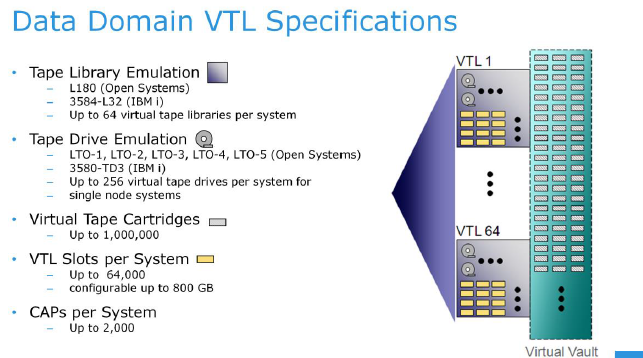
The challenges with traditional VTL's include disk costs are too expensive for long-term retention. Backup data is too large to replicate over the WAN to a DR site. They still require of creating physical tapes to support post backup operations.


To summarize the benefits of Data Domain VTL, it starts with economics. There is less disk to resource and less to manage. The CPU-centric deduplication approach of SISL allows the system to be simpler to manage, as well as easier to provision.
In addition, Data Domain is more mature and flexible than most of its competitors. Finally, because of their resilience and replication flexibility Data Domain systems are highly reliable when deployed for VTL environments.


Data Domain systems support backups over the SAN and LAN. The backup application manages all data movement to and from Data Domain systems. The backup application manages physical tape creation. Data Domain replicator software manages virtual tape replication, and Data Domain System Manager is used to configure and manage tape emulations.


DD OS includes an NDMP tape server feature that simplifies the deployment of Data Domain systems for network attached storage or NAS devices. The feature is ideal to provide data protection for NAS systems and data centers or remote offices that use an Ethernet infrastructure, and complements the existing VTL over Fibre Channel capability.
The capability is included with purchase of the VTL software option, bundled with Fibre Channel HBA's, and is available to the VTL installed base.


Usefull Link:


.

EMC Data Domain DD Boots

.

Data DomainBoost extends optimization capabilities of Data Domain solutions. The main advantages for DD Boost are improved throughput, backup server managed file replication and backup server replication awareness.


The benefits of DD Boost include improved throughput. This is improved throughput of retaining data backups that is accomplished with the open storage technology (OST) protocol, and the Data Domain Distributed Segment Processing, DSP. OST, when compared to CIFS and NFS protocols, has a faster throughput.
The Distributed Segment Processing offloads part of the deduplication process to the backup server. Why is backup server managed file replication beneficial?
Without DD Boost, replication is initiated and managed by the Data Domain system. The backup server is not aware of the data written on the replica Data Domain system, system B in the diagram. With DD Boost, the backup server can now control and manage file replication. Why is this backup server awareness of the replica Data Domain system beneficial? Because DD Boost allows for the backup server to be aware of the replica system, it can directly restore and recover from the replica. Prior to DD Boost, the backup server didn't control or manage replica data. This made restoring the data from replica a manual process.


Let's compare deduplication process with and without DSP. in this illustration, the deduplication process is performed on the Data Domain system without DSP. Without DSP enabled, the entire deduplication process is performed on one system.
The Data Domain goes through the process of segmenting, fingerprinting, filtering, compressing, and finally writing the data to disk. The backup server has no part in the deduplication process


With DSP enabled, the process is distributed between the backup server and the Data Domain system. The creation of segments and fingerprints, along with the segment compression, is performed on the backup server. The Data Domain system filters the fingerprints and writes the segments to the Data Domain system disk.
Note that the overall deduplication process remains the same with or without DSP. Enabled DSP merely changes which component – whether the backup server or the Data Domain system – performs parts of the process


The DD Boost advanced load-balancing and link failover functionality supports transparent failover of jobs. In-flight jobs on failed ports on the DD system are transparently moved to healthy links on the Data Domain system, and subsequent jobs are sent to the healthy links. This further improves the enterprise robustness of the backup environments that use Data Domain Boost.

Useful Link:


EMC Data Domain Fundamentals

Increasing the capacity speed and cost-effectiveness of data storage is a perpetual challenge. One of the most expensive and resource intensive tasks is gathering storing and protecting data backups. Writing data to tape and shipping and storing the tapes off-site is one of the largest financial and labor resource challenges in the conventional tape centric environment. The diagram illustrates the conventional process of handling backups through backup servers which then store that content in tape libraries. The tapes may be retained on-site for quick retrieval or in some cases shipped and stored off-site and data recovery must reverse the steps with an involved manual process of moving the data back on site.
Data Domain systems simplify the storage and handling of data by reducing, or in many cases entirely eliminating, the need for tape for data storage.
With Data Domain systems, data is backed up to disk instead of to tape. Data domain deduplication greatly reduces the data footprint before the data is backed up. Data domain global compression technology combines an exceptionally efficient high-performance in-line deduplication technology with a local compression technique. The reduced data footprint allows data to be retained on-site for longer periods and allows transfer across the network for archival. Data recovery is similarly transformed by the elimination of the time-consuming and resource intensive handling of tape.

This illustration provides a quick snapshot of the evolution of backup and recovery from tape to disk. From top to bottom, the conventional tape centric backup and recovery process has evolved from a heavily burdened manual process to some degree of automation with the introduction of VTL or virtual tape library systems.
More recently, the introduction of disk-based technologies such as Data Domain systems have transformed the process, providing both hybrid digital emulation of virtual tape library systems, as well as purely disk-based backup recovery and archival solutions.
Moving from left to right in the diagram, the move from tape to disk has had a significant effect on each important stage of the process including seamless integration with a wide variety of application backup clients and media management architectures. The move also provides a smaller footprint in the on-site backup storage space, and fast and efficient disaster recovery involving a process known as replication. With replication, disk-based backup data is replicated or copied off-premise to the disaster recovery site also known as the DR site. A number of additional Data Domain technologies provide a unique level of protection at the DR site.


For archiving and compliance solutions, Data Domain systems allow customers to cost-effectively archive non-changing data while keeping it online for fast reliable access and recovery.
These capabilities free up expensive storage to significantly improve operational efficiency and control costs. Data Domain provides a capacity optimized storage tier for backup and archive of data in a single system. File level retention locking enables active archive protection for IT governance. Data Domain systems offer field proven and automated data replication, data deduplication, enterprise management, and built-in data safety for extended on-site and off-site retention and recovery.
In combination, these capabilities enhance compliance and eDiscovery, allowing customers to adhere to government industry corporate and legal mandates


Useful Link:

EMC Data Domain Fundatmentals Free Traning


EMC Data Domain Deduplication Storage Systems 

Back to Basics: EMC Data Domain Overview


EMC Backup and Recovery with Data Domain


..